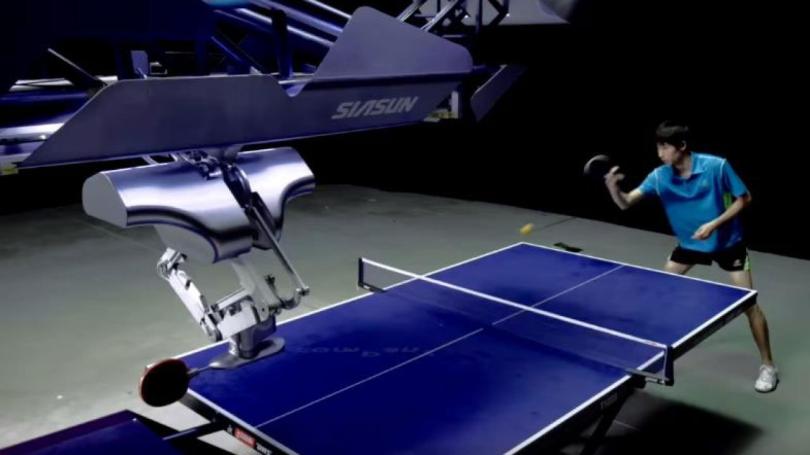
The End of Human Dominance?
For over 40 years, humans have maintained their edge over robots in the world of table tennis. However, recent breakthroughs at Google DeepMind suggest that this dominance may be fading. A preprint paper released on August 7 reveals the creation of a groundbreaking robotic system that can perform at an amateur human level in ping pong—and there are videos to back it up.
Why Table Tennis?
When it comes to testing the strategic and physical capabilities of artificial intelligence, researchers often turn to classic games like chess and Go. However, table tennis presents a unique challenge by combining strategy with real-time physical demands. The sport’s fast-paced nature, requiring quick adaptation to dynamic variables, complex motions, and precise visual coordination, has made it a standard in robotics for decades.
“The robot has to be good at low-level skills, such as returning the ball, as well as high-level skills, like strategizing and long-term planning to achieve a goal,” explained Google DeepMind in a post on X.
- https://www.linkedin.com/pulse/splunk-splk-3003-dumps-easy-exam-achievement-supreme-certs-ul7le
- https://www.linkedin.com/pulse/splunk-splk-2001-dumps-easy-exam-achievement-supreme-certs-vsnge
- https://www.linkedin.com/pulse/renewed-splunk-splk-3003-exam-questions-2024-pdf-version-kajfe
- https://www.linkedin.com/pulse/smc-dumps-practice-questions-2024-increase-your-score-certs-web-hjmue
- https://www.linkedin.com/pulse/splunk-splk-3003-dumps-questions-pdf-definite-study-hacks-w1rte
- https://www.linkedin.com/pulse/splunk-splk-2001-dumps-questions-pdf-definite-study-hacks-hx66e
- https://www.linkedin.com/pulse/premier-splunk-splk-3003-exam-questions-updated-2024-quick-achievement-osx9e
- https://www.linkedin.com/pulse/splk-2001-dumps-practice-questions-2024-increase-your-score-bhexe
- https://www.linkedin.com/pulse/isc2-sscp-dumps-questions-pdf-definite-study-hacks-ivented-nbfje
- https://www.linkedin.com/pulse/sscp-dumps-practice-questions-2024-increase-your-score-ivented-l692e
Building the Perfect Ping Pong Bot
To create their advanced ping pong robot, engineers at Google DeepMind started by compiling a vast dataset of “initial table tennis ball states,” which included details on position, spin, and speed. The AI system was then trained in highly accurate virtual simulations, where it learned various skills like returning serves, aiming backhands, and executing forehand topspins.
Next, the AI was integrated with a robotic arm capable of complex and rapid movements. The data collected during its matches with human players, including visual input from onboard cameras, was fed back into the AI system to refine its performance through a continuous learning loop.
The Human-Robot Showdown
To put their creation to the test, Google DeepMind arranged a tournament with 29 human players, ranging from beginners to advanced competitors. The robot, mounted on a track for optimal movement, took on players across four skill levels—beginner, intermediate, advanced, and “advanced+.” Impressively, the machine won 13 out of 29 matches, or 45 percent of its challenges, achieving what the researchers described as a “solidly amateur human-level performance.”
Human Players Still Hold the Edge—For Now
Table tennis enthusiasts can take some comfort in knowing that, while the robot bested every beginner-level player, it only won 55 percent of its matches against intermediate opponents and was unable to secure a victory against the advanced players. Despite these results, participants described their experience with the robot as “fun” and “engaging,” with many expressing a strong desire for rematches.
A Glimpse Into the Future
The creation of this ping pong robot marks a significant milestone in AI and robotics, showcasing the potential for machines to compete with humans in physical and strategic activities. While humans still hold an advantage, the advancements at Google DeepMind suggest that the gap between human and robot performance is narrowing—and that the future of sports might just include some robotic competition.
 Trending Wires