Reimagining Creativity and Productivity
Imagine the legendary guitarist Jimi Hendrix pushing the boundaries of sound with an additional thumb, or historic painters like Frida Kahlo and Vincent Van Gogh completing their masterpieces with greater ease. Such scenarios may soon become reality with the advent of a new 3D-printed robotic wearable called “The Third Thumb.” Designed to augment human capabilities, this device represents a significant step forward in wearable motor augmentation technology, aiming to enhance accessibility and functionality.
How the Third Thumb Works
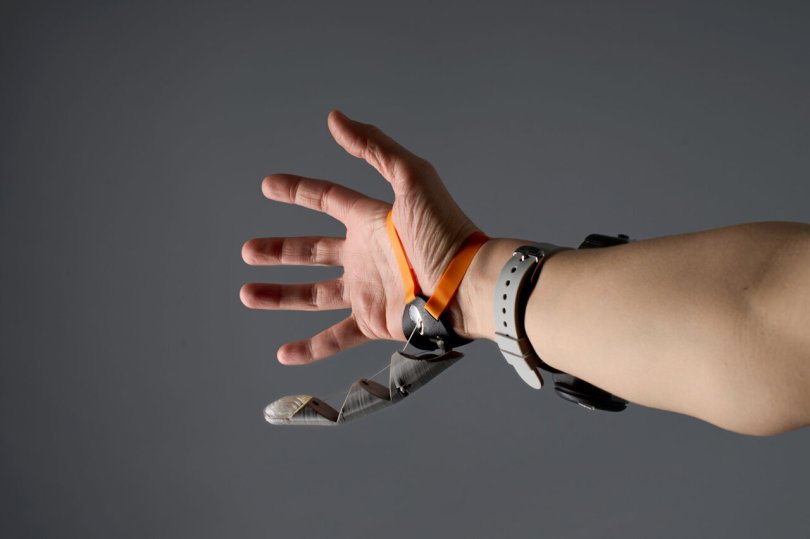
Developed by Dani Clode from the University of Cambridge, The Third Thumb is a cutting-edge, 3D-printed robotic appendage controlled by the user’s toes. Here’s how it functions:
- Design and Operation: The device is strapped to the wrist and sits on the opposite side of the palm from the user’s natural thumb, resembling an extended finger. It is operated via two sensors placed under the big toes: the right toe controls horizontal movement and the left toe controls vertical movement. The device’s wireless, proportional controls translate toe pressure into thumb movements, allowing for precise manipulation of objects.
- Potential Applications: Beyond aiding those who have lost limbs, The Third Thumb could significantly enhance various biological functions, potentially making complex tasks easier and more efficient. Researchers envision it improving productivity and safety across diverse fields.
- https://www.linkedin.com/pulse/servicenow-cis-rci-dumps-questions-pdf-definite-study-hacks-9zwee
- https://www.linkedin.com/pulse/servicenow-cis-hr-dumps-questions-pdf-definite-study-hacks-1t4ke
- https://www.linkedin.com/pulse/acfe-cfe-investigation-dumps-questions-pdf-definite-study-hacks-seb9e
- https://www.linkedin.com/pulse/servicenow-cis-csm-dumps-questions-pdf-definite-study-hacks-bhwqe
- https://www.linkedin.com/pulse/servicenow-cis-csm-exam-questions-accurate-2024-easy-way-pass-ikcie
- https://www.linkedin.com/pulse/apics-cpim-dumps-questions-pdf-definite-study-hacks-blissol-vbtge
- https://www.skool.com/real-exam-dumps-3783/cis-ppm-dumps-2024-best-study-approaches-for-the-servicenow-cis-ppm-exam
- https://www.skool.com/real-exam-dumps-3783/cof-c02-dumps-2024-best-study-approaches-for-the-snowflake-cof-c02-exam
- https://www.skool.com/real-exam-dumps-3783/cpp-remote-dumps-2024-best-study-approaches-for-the-apa-cpp-remote-exam
- https://www.skool.com/real-exam-dumps-3783/cma-dumps-2024-best-study-approaches-for-the-imanet-cma-exam
Broad Testing and Impressive Results
The Third Thumb has undergone extensive testing, with researchers presenting it at the 2022 Royal Society Summer Science Exhibition. Over five days, 596 participants, ranging from ages 3 to 96, tested the device. Key findings include:
- Ease of Use: An impressive 98% of participants were able to don the device and manipulate objects within one minute of use. The tests included grasping pegs from a pegboard and handling various foam objects, with over half of the participants successfully completing both tasks.
- Inclusivity: The results showed no significant differences in performance based on age, gender, or handedness, highlighting the device’s broad applicability and effectiveness across diverse user demographics.
Ethical Considerations and Future Prospects
The researchers emphasize the importance of inclusivity in the design of wearable technology. As Professor Tamar Makin notes, ensuring these devices are accessible to all, particularly marginalized communities, is essential for equitable technological advancement.
- Design Philosophy: Dani Clode underscores that The Third Thumb’s design aims to be as inclusive as possible, addressing potential disparities in technology use and ensuring that advancements benefit a wide range of users.
- Real-World Applications: Initial demonstrations of The Third Thumb reveal its potential for practical tasks—such as squeezing fruit, pinching thread, and even playing guitar—showcasing its versatility and utility.
Conclusion
The Third Thumb represents a groundbreaking development in wearable technology, offering new opportunities for enhancing human capability. While learning to use the device may initially seem unusual, the recent research indicates that it is both intuitive and effective. As technology continues to evolve, The Third Thumb could play a significant role in expanding the boundaries of what is possible for creators and everyday users alike.
 Trending Wires