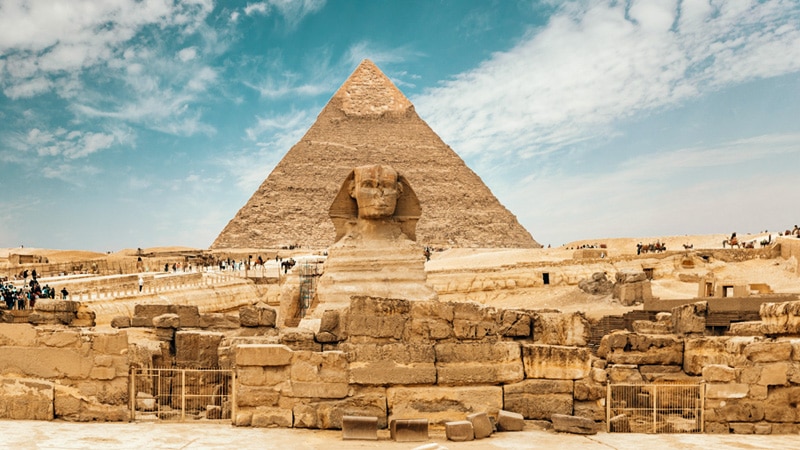
The Ancient Wonder of Saqqara
The Step Pyramid of Djoser, Egypt’s oldest necropolis, stands as a testament to the ingenuity of ancient Egyptian civilization. Built around 2,680 BCE during the Third Dynasty by Pharaoh Djoser, this iconic six-tiered, four-sided pyramid rises 205 feet above the sands of Saqqara, near the ancient city of Memphis. While the methods used to construct this monumental structure have long intrigued historians, a new study suggests that the Egyptians may have employed a sophisticated tool previously unknown—a hydraulic lift system powered by a nearby, now-vanished lake.
A Revolutionary Discovery
An interdisciplinary team from France’s CEA Paleotechnic Institute revealed their groundbreaking findings on August 5 in the journal PLOS One. By combining satellite imagery, geospatial analysis, and ancient watershed data, the researchers have uncovered evidence of a structure near the pyramid that likely functioned as a “check dam.” This ancient engineering marvel, designed to slow and manage water flow, may have played a crucial role in the pyramid’s construction.
- https://www.linkedin.com/pulse/premier-comptia-sy0-701-exam-questions-updated-2024-quick-achievement-lsgoe
- https://www.linkedin.com/pulse/renewed-isc2-sscp-exam-questions-2024-pdf-version-ivented-8yrme
- https://www.linkedin.com/pulse/renewed-comptia-sy0-701-exam-questions-2024-pdf-version-ivented-0nble
- https://www.linkedin.com/pulse/premier-isc2-sscp-exam-questions-updated-2024-quick-achievement-9iwle
- https://www.linkedin.com/pulse/isc2-sscp-dumps-easy-exam-achievement-omnelyx-sik5e
- https://www.linkedin.com/pulse/comptia-sy0-701-dumps-questions-pdf-definite-study-hacks-omnelyx-5c4ee
- https://www.linkedin.com/pulse/splk-3003-dumps-practice-questions-2024-increase-your-score-6dw8e
- https://www.linkedin.com/pulse/comptia-sy0-701-dumps-easy-exam-achievement-omnelyx-pbhxe
- https://www.linkedin.com/pulse/premier-salesforce-tableau-crm-einstein-discovery-consultant-exam-2w2oe
- https://www.linkedin.com/pulse/renewed-salesforce-tableau-crm-einstein-discovery-consultant-suyce
The Hydraulic Lift in Action
According to the study, water from a nearby source would have been channeled through a series of compartments, allowing sediment to settle while the water passed through each chamber. This process likely served not only as a method of filtration but also as a means to operate a hydraulic lift system. The lift, which could rise to a height of around 55 feet, may have been used to raise massive stone blocks into place during the pyramid’s construction. Researchers speculate that the lift could have been extended even higher using collapsible structures and may have doubled as a counterweight in a pulley-and-rope system.
Beyond Construction: A Multi-Functional System
The potential existence of this hydraulic lift challenges long-held beliefs about the capabilities of ancient Egyptian engineering. The system’s dual functionality—serving both as a construction tool and as a water treatment facility—demonstrates the foresight and planning of the pyramid’s architects. By managing water resources effectively, they not only facilitated the construction of the pyramid but also made the surrounding Saqqara region more hospitable for permanent settlement, agriculture, and long-term shelter.
Implications for Other Ancient Structures
The study’s findings suggest that similar hydraulic systems could have been used in the construction of other Old Kingdom pyramids, and possibly even earlier structures. While more research is needed to confirm these hypotheses, this discovery opens new avenues for understanding the advanced engineering techniques employed by ancient Egyptians.
The Path Forward
To truly grasp the extent of ancient Egypt’s engineering prowess, continued exploration and analysis of these historical sites are essential. As researchers delve deeper into the ruins of the past, they may uncover even more sophisticated technologies that challenge our understanding of what ancient civilizations were capable of achieving.






 Trending Wires